

Beyond Recycling: The Global Circularity Protocol in Practice
From material flows to circularity KPIs, we explore how businesses can measure circularity in practice using the Global Circularity Protocol.

Measuring sustainability in a consistent and systematic way across various types of businesses is a challenge. Every company measures impact differently. Not because they are trying to hide something or cover up indiscretions but because every company is fundamentally different in the products it produces, the materials it requires and the processes it employs to produce those products. Consider the differences between a train operator, a hospital, a manufacturer or a retailer. Their business models, supply chains, material flows and waste streams barely resemble one another. That’s the challenge with sustainability measurement. There is rarely one simple metric that captures everything in a meaningful way. And when metrics are simplified enough to work universally, they often become too abstract to provide real operational insight.
That’s why frameworks like the GHG Protocol became so important. Scope 1, 2, and 3 emissions created a shared language for carbon accounting across organisations, even when their operations looked completely different. Now circularity is entering a similar phase. The emerging Global Circularity Protocol (GCP) aims to create a common methodology for measuring how materials flow through products, operations, and value chains. It aims to help businesses move beyond isolated recycling figures toward a more complete understanding of material circularity.
One of the most unique aspects about GCP is that it is not emerging as a purely regulatory initiative but rather a voluntary, collaborative framework being developed with input from major manufacturers, technology companies, sustainability organisations and policy stakeholders who increasingly recognise the business importance of circularity measurement and material visibility. The initiative has involved organisations including the World Business Council for Sustainable Development (WBCSD), the One Planet Network hosted by UNEP, the Ellen MacArthur Foundation, and companies such as Apple, Cisco, Google, IKEA, Panasonic, and Trane Technologies.
That industry involvement matters. It signals that circularity is increasingly being treated not only as a sustainability topic, but as a long-term operational and strategic business issue connected to material security, supply chain resilience, product design, and future competitiveness.
How the Global Circularity Protocol maps material movements
At its core, the Global Circularity Protocol proposes a univeral framework to map how materials move through a business across both operations and value chains. The methodology distinguishes between:
- materials entering operations (scope A)
- materials retained within products and processes (scope B)
- materials leaving operations during production (scope B)
- and materials recovered downstream after product use (scope C)
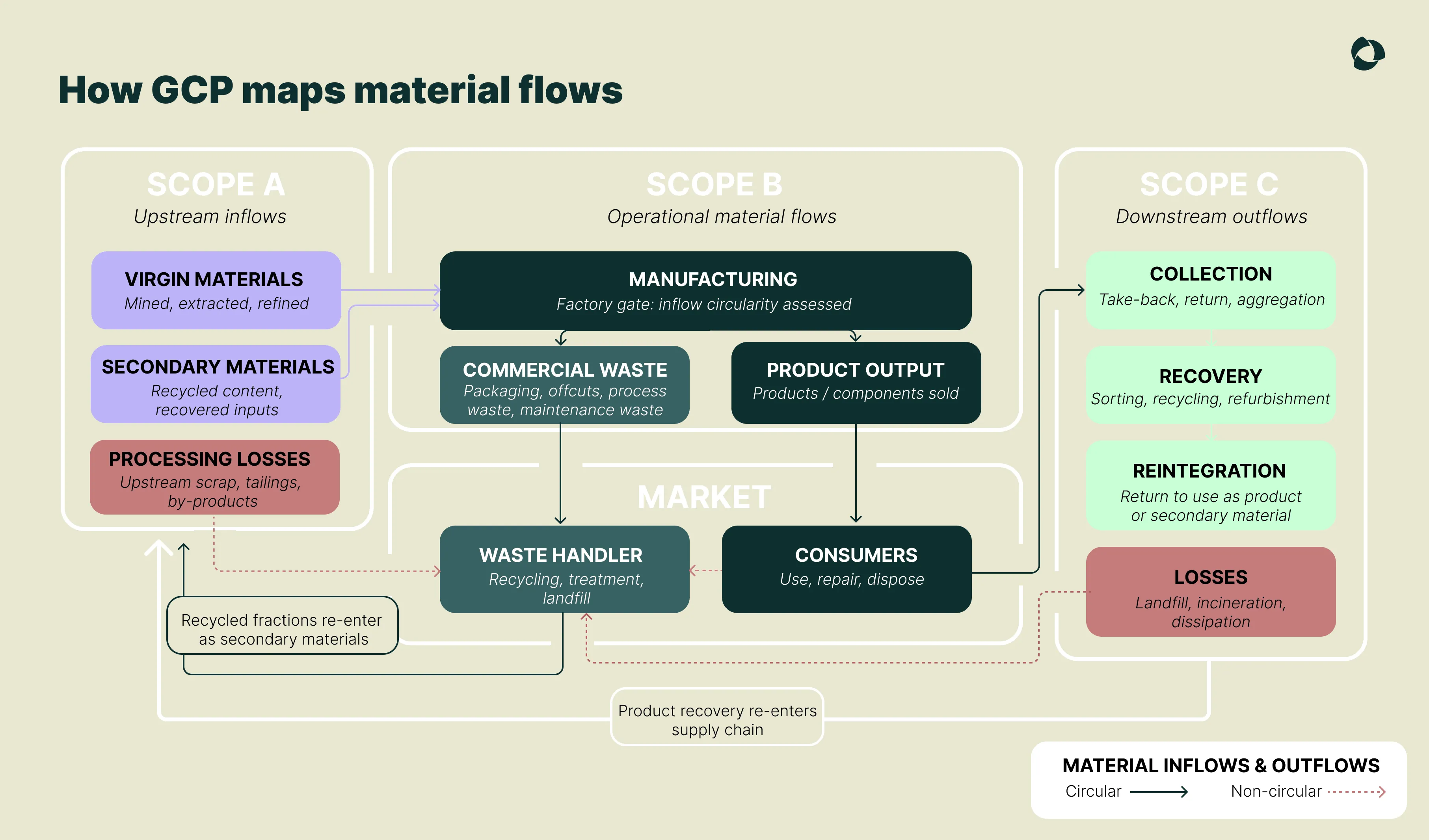
This holistic approach takes into consideration the different realities for different products while establishing a robust and comparable framework for comparison. Circularity is not only about whether products are eventually recycled or returned through take-back systems. A significant portion of material loss often happens much earlier during manufacturing and operational processes themselves.
A shared methodology for mapping material movements also creates the possibility to have shared KPIs and create a shared language around circularity that enables businesses to set targets, measure progress, benchmark and share best practices in a much more meaningful way.
.webp)
Scope A: Circular inflow
How circular are the materials entering the business?
This scope focuses on the origin and composition of material inputs entering operations. The objective is to understand how much of a company’s inflow comes from secondary raw materials, recycled feedstock, reused components, renewable materials or other circular sources rather than virgin extraction.
Example metrics
- % circular inflow
- Virgin vs secondary input ratio
- Upstream material footprint
- Processing yield losses
Scope B: Operational circularity
How effectively does the business retain material value during operations?
This scope focuses on how materials move through manufacturing and operational processes. It examines production losses, commercial waste streams, internal reuse, process efficiency and operational recovery systems in order to understand how much material value is retained versus lost during operations.
- Operational inflow circularity
- Commercial waste recovery rate
- Internal recirculation rate
- Production scrap rate
- Packaging intensity
Scope C: Circular outflow
What happens to materials after products leave the organisation?
This scope focuses on downstream recovery and reintegration pathways after product use. It attempts to measure whether products and materials are collected, refurbished, remanufactured, recycled or ultimately lost from productive economic circulation.
- Recovery potential
- Actual recovery rate
- % circular outflow
- Reintegration rate
- Material loss / leakage rate
System level: Material circularity
How effectively does the overall system keep materials in productive circulation?
At the system level, inflows, operational losses and downstream recovery outcomes are combined to create a broader picture of overall circularity performance across the organisation.
- % material circularity
- Circular material retention
- Material circularity revenue
- Circular material productivity
Circularity measurement is fundamentally operational
.webp)
Unlike carbon accounting, circularity measurement is tied directly to physical material flows and the operational realities surrounding them. Two products may both contain recoverable materials, yet their circularity potential can look completely different depending on how they are produced, used, maintained, collected, and recovered at end-of-life. Understanding circularity therefore requires far more than a single recycling figure. Organisations need visibility into material sourcing, production losses, product design, repairability, take-back systems, refurbishment pathways, downstream recovery outcomes, and whether recovered materials actually retain productive value after use. The comparison below illustrates how the same circularity principles can create entirely different operational realities across industries.
The comparison above highlights why circularity measurement quickly becomes operationally complex in practice.
An industrial motor may appear comparatively straightforward from a circularity perspective because it contains highly recoverable materials such as copper, steel, and aluminium. But even here, the reality depends on far more than material composition alone. Circularity outcomes are influenced by production scrap, machining waste, maintenance cycles, disassembly design, refurbishment pathways, recovery infrastructure, and whether recovered metals are ultimately reintroduced into high-value industrial applications or downcycled into lower-grade uses.
An endoscope presents an entirely different set of challenges. While many components may still contain recoverable materials, the product exists within a heavily regulated healthcare environment shaped by sterilisation requirements, infection control standards, traceability obligations, contamination risks, and complex multi-material construction. In practice, these operational constraints can significantly influence how products are collected, separated, refurbished, recovered, or disposed of at end-of-life.
In both cases, circularity cannot be reduced to a single recycling figure or universal KPI. It requires understanding how materials move through the full operational lifecycle of a product from sourcing and manufacturing through use, recovery, reintegration, and potential material loss.
The operational challenge at the heart of circularity calculations
This is where many organisations encounter the real challenge. The information required for meaningful circularity calculations rarely exists in one place. Instead, it is fragmented across procurement systems, supplier declarations, ERP platform, compliance reporting tools, invoices and spreadsheets. And this complexity grows exponentially when businesses attempt to assess entire product portfolios across multiple sites, suppliers, and regions. Circularity measurement therefore becomes much more than a reporting exercise. It becomes a data infrastructure and operational visibility challenge.
Circularity measurement is also becoming a strategic business issue
For many manufacturers, circularity is no longer viewed primarily as a sustainability initiative. It is increasingly becoming a question of supply chain resilience, material security, and long-term competitiveness.
Over the past few years, global supply chain disruptions, geopolitical tensions, tariffs, and growing competition for critical raw materials have exposed how vulnerable many industries are to linear sourcing models. Companies that depend heavily on metals, batteries, electronics, polymers, or rare earth materials are recognising that material availability itself may become a strategic risk. That is one of the reasons manufacturers are doubling down on circularity more aggressively than ever before.
The ability to recover, retain, and recirculate valuable materials internally creates a level of resilience that traditional linear supply chains simply cannot offer. A manufacturer capable of sourcing secondary materials from its own production waste streams, take-back systems, or recovery networks is significantly less exposed to volatility in raw material markets and geopolitical disruption. In some sectors, the ability to recover strategic materials from existing products or operational waste streams could eventually become business-critical. Rare earth elements, battery materials, technical metals, and high-performance polymers are all becoming increasingly important in discussions around industrial policy, energy transition, and supply security.
At the same time, regulatory pressure around recycled content, waste reduction, reporting requirements, and extended producer responsibility continues to increase. The result is that circularity is rapidly moving from a niche sustainability topic into a cross-functional business priority involving procurement, operations, product design, logistics, compliance, and executive leadership. Many large manufacturers now have entire teams dedicated specifically to circular economy strategy, material recovery, closed-loop systems and circular product design.
And while implementation remains operationally challenging, the potential upside is enormous. Beyond sustainability outcomes, organisations are pursuing circularity because they increasingly see the business value:
- reduced dependency on virgin materials
- stronger supply chain stability
- improved resource efficiency
- lower material costs over time
- increased recovery of high-value materials
- and greater control over long-term material availability
At the same time, the long-term cost of not building circular systems could become increasingly significant for businesses operating in resource-intensive industries. In many ways, this is a defining moment for industrial circularity.
Why operational systems will define the future of circularity measurement
The reality is that most organisations are nowhere near equipped to operationalise circularity measurement at scale. The required data is fragmented across product systems, supplier documentation, waste reporting, logistics providers, ERP platforms, recovery partners, spreadsheets, and disconnected sustainability tools.
And that fragmentation makes one thing almost impossible: getting a truly complete picture of how circular a business actually is.
That is exactly the problem Resourcify was built to solve. Resourcify combines AI-powered product portfolio circularity assessment with commercial waste reporting, take-back systems, and closed-loop program management in one connected platform. Instead of treating circularity as isolated reporting exercises spread across different departments and tools, the platform enables organisations to assess, pilot, launch, scale, and continuously track circular initiatives across the full material lifecycle. At the upstream level, Resourcify’s AI-powered Product Check analyses product portfolios using authoritative industry datasets to assess:
- material composition
- recycled content
- recyclability
- recovery pathways
- reuse opportunities
- take-back feasibility
- and closed-loop potential
.png)
Customers can further customise and refine this intelligence according to their own operational standards, supplier relationships, and product realities. But product circularity is only one piece of the equation. Unlike standalone product assessment tools, Resourcify also tracks operational commercial waste streams, downstream recovery outcomes, and the real-world performance of take-back and closed-loop programs.
That means businesses can finally connect:
- upstream material inputs
- operational waste generation
- downstream recovery
- and circular reintegration
inside one operational system.
And that is where circularity measurement becomes genuinely powerful.
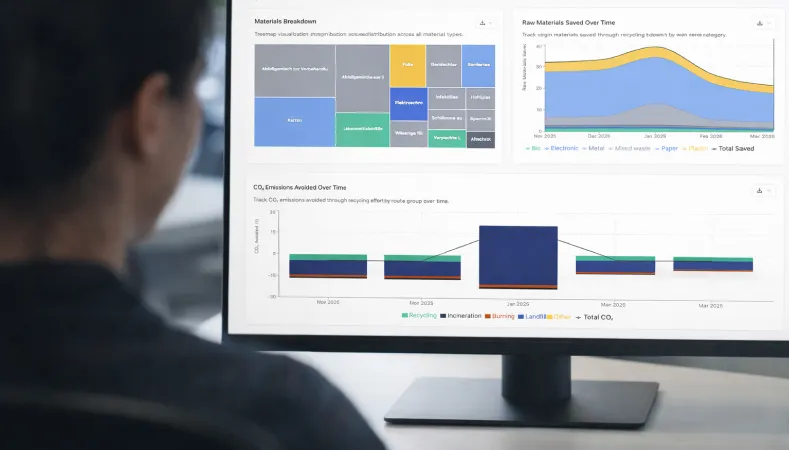
Because once organisations can connect product data, waste flows, recovery outcomes, and closed-loop performance in real time, they move beyond theoretical circularity discussions and start building measurable circular operations at scale.
Ultimately, companies are trying to answer a deceptively difficult question:
How circular are we, really?
For most businesses, that answer cannot come from a single recycling figure, a spreadsheet, or a yearly sustainability report.
It requires connected operational visibility across the entire material lifecycle.

.webp)
Trusted by



Get the latest insights delivered direct to your inbox
