The EU’s Updated ELV Regulation for Auto Manufacturers
Circularity is evolving in automotive. The updated EU ELV regulation introduces new recycled content targets and operational challenges across material flows.

The EU’s updated End-of-Life Vehicles (ELV) regulation marks the next step in Europe’s transition toward a more circular automotive industry. While the original ELV Directive has been in place since 2000, the revised framework strengthens expectations around recycled materials, circular design and producer responsibility.
For automotive manufacturers, circularity itself is not new. Vehicle dismantling, material recovery and compliance reporting have long been part of the regulatory landscape. What is changing is the level of accountability required to demonstrate that circularity targets are actually being met.
The shift is less about introducing entirely new obligations and more about operationalising circularity across increasingly complex material flows.
From the ELV Directive to a lifecycle approach
The original ELV Directive focused primarily on ensuring that vehicles could be dismantled and recycled at the end of their life. It established targets for reuse, recycling and recovery while restricting hazardous materials in vehicle production.
The updated regulation builds on this foundation but expands its scope. Rather than focusing only on end-of-life treatment, the revised framework increasingly addresses circularity across the entire vehicle lifecycle.
This includes:
- Minimum recycled content requirements for plastics
- Stronger circular design expectations
- Expanded producer responsibility obligations
- Stricter monitoring of vehicle exports and treatment activities
Together, these measures aim to increase both material recovery rates and transparency across automotive value chains.
Recycled plastic targets
One of the most visible elements of the updated regulation is the introduction of minimum recycled plastic content requirements in new vehicles.
Under the proposed framework:
- 15% recycled plastic content must be achieved within six years of implementation
- 25% recycled plastic content within ten years
- 20% of this recycled content must come from closed-loop recycling
These targets are intended to stimulate demand for high-quality recycled plastics and strengthen the economics of automotive recycling systems.
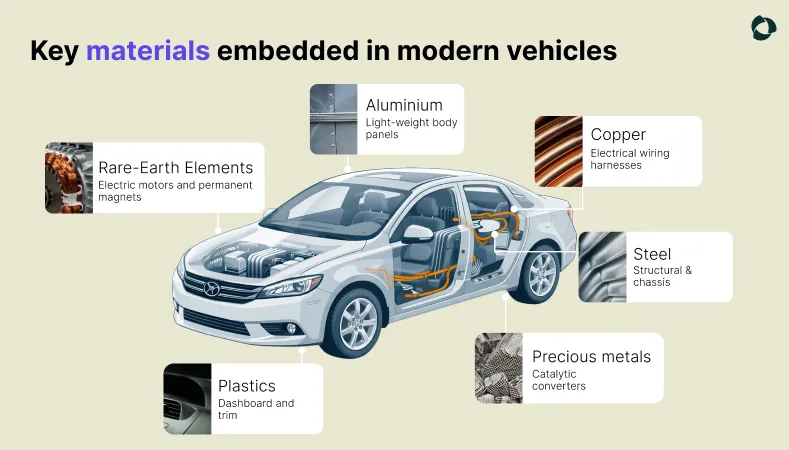
The regulation also anticipates further material-specific targets. Feasibility assessments are currently underway for recycled steel and aluminium, with additional studies planned for critical raw materials used in vehicle manufacturing.
Circular design and End-of-Life readiness
Beyond recycled content requirements, the regulation also strengthens expectations around vehicle design for circularity.
Vehicles must be designed to support easier removal, reuse and recovery of components and materials once they reach the end of their operational life. Improving dismantling accessibility and recovery processes helps ensure that valuable materials embedded in vehicles can be captured efficiently by treatment facilities.
For manufacturers, this reinforces the importance of considering material recovery during the design phase, rather than treating recycling purely as a downstream activity.
Reinforced producer responsibility
The revised regulation also strengthens the principle of Extended Producer Responsibility (EPR).
Manufacturers remain responsible for ensuring that end-of-life vehicles are properly collected and treated. The updated framework increases oversight through tighter monitoring of treatment activities, stronger inspection requirements and stricter rules governing vehicle exports.
These measures aim to ensure that vehicles exported outside the EU are roadworthy and to prevent valuable materials from leaving the European circular economy prematurely.
The operational challenge: demonstrating compliance
For most automotive manufacturers, many of these concepts are already familiar. Material reporting, recyclability assessments and treatment monitoring have long been part of regulatory compliance.
What is changing is the level of data integrity expected to support these claims.
Meeting recycled content targets, demonstrating circular design readiness and verifying proper treatment outcomes all depend on reliable information about materials and volumes across complex supply chains and recovery networks.
In many organisations, this information already exists but it is often fragmented across multiple systems and operational stages.
As circularity requirements expand, the challenge increasingly becomes one of structured lifecycle data management.
The systems that already exist
The automotive industry already uses several systems to manage material information.
For example:
- IMDS (International Material Data System) is used to declare material composition from suppliers
- PLM systems track materials and components during vehicle design
- ERP and manufacturing systems record production volumes and part numbers
- Recycling and compliance reporting systems document dismantling and recovery outcomes
Each of these systems captures important pieces of information. However, they were not originally designed to create a continuous circular material record across the entire lifecycle of a vehicle.
Where lifecycle data needs to connect
To demonstrate circular performance and regulatory compliance, material information increasingly needs to be captured and connected across several stages.
Vehicle design
Material composition and component data are defined through PLM systems and supplier declarations in IMDS.
Manufacturing
Production systems record material inputs, part numbers and volumes through ERP and manufacturing execution systems.
Collection and EOL processing
When vehicles reach end of life, treatment facilities document dismantling processes, material separation and recycling outcomes.
Material recovery and reuse
Recovered materials are processed into secondary raw materials that may re-enter automotive supply chains.
The regulatory challenge is not necessarily collecting new information, but connecting the information that already exists across these stages.
Toward greater transparency in automotive material flows
The revised ELV regulation signals a broader shift toward greater accountability and transparency in automotive material flows.
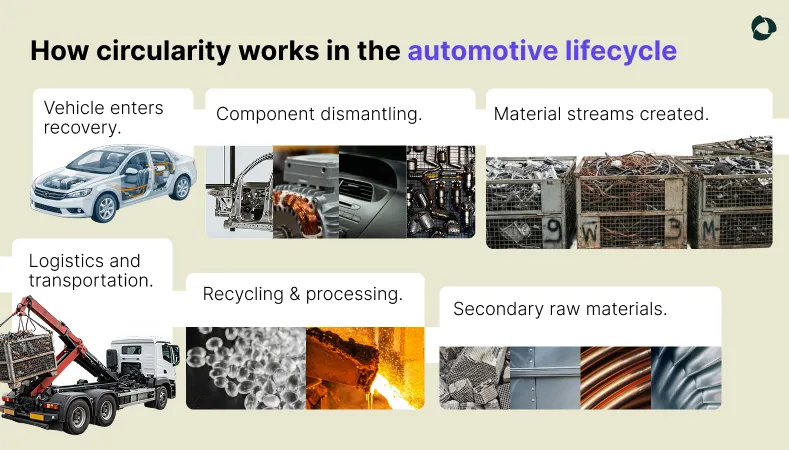
Rather than focusing only on recycling outcomes, the regulatory framework increasingly requires manufacturers to demonstrate how materials move through circular recovery processes - from vehicle dismantling through to the generation of secondary raw materials.
For manufacturers, circularity is therefore becoming not just a sustainability objective but also an operational challenge.
Meeting recycled content targets, demonstrating circular design readiness and verifying treatment outcomes all depend on reliable documentation of what happens once vehicles and components re-enter recovery systems.
Capturing these processes in a structured and auditable way is becoming an increasingly important part of circularity programs.
Running circular programs at scale
In practice, circular recovery programs involve far more than simply reporting recycling outcomes.
Products must first be reacquired, collected and transported to recovery facilities. Components are dismantled, materials are separated and recycling partners transform them into secondary raw materials that can potentially re-enter supply chains.
Across this process, multiple partners are involved from logistics providers to dismantling facilities and specialised recyclers.
Coordinating these operations while documenting chain-of-custody events, material transformations and recovered volumes becomes essential for demonstrating circular performance.
How Resourcify supports circular recovery programs
Resourcify helps companies operate circular recovery programs and document the material flows they generate.
The platform supports the operational side of circularity by enabling organisations to coordinate collection, logistics and recycling workflows across their partner networks. Products and materials can be reacquired, transported and processed through fully customisable recovery stages while maintaining full operational visibility.
At the same time, Resourcify digitally documents the chain of custody and material transformations that occur throughout these processes. Material weights, recovery outputs and recycling stages are captured in a structured way, creating a reliable record of how products are transformed back into materials.
This makes it possible to demonstrate recycled material volumes, closed-loop flows and recovery outcomes with greater transparency - supporting both regulatory compliance and the broader transition toward a circular automotive industry.




Trusted by






Get the latest insights delivered direct to your inbox