

Circularity as an industrial strategy: the Critical Raw Materials Act (CRMA)
How the EU Critical Raw Materials Act (CRMA) is reshaping how manufacturers think about supply chain resilience, material recovery and circularity.

Critical Raw Materials Act: What manufacturers need to know
The Critical Raw Materials Act has been part of European industrial policy since 2024, but many manufacturers still misread what it actually is. Most summaries either bury it in regulatory jargon or reduce it to a recycling story. It's actually neither.
The CRMA is a strategic industrial policy framework. Understanding that distinction is the starting point for understanding what it demands of businesses now and in the future and why it matters beyond the companies it directly touches.
What the Critical Raw Materials Act actually requires
The regulation was designed to address a structural vulnerability in Europe's industrial economy: deep dependency on a small group of materials that are essential for batteries, semiconductors, renewable energy infrastructure and advanced manufacturing. Lithium, cobalt, nickel, graphite, copper and rare earths are essential for batteries, semiconductors, renewable energy infrastructure and advanced manufacturing but are overwhelmingly sourced and processed outside Europe.
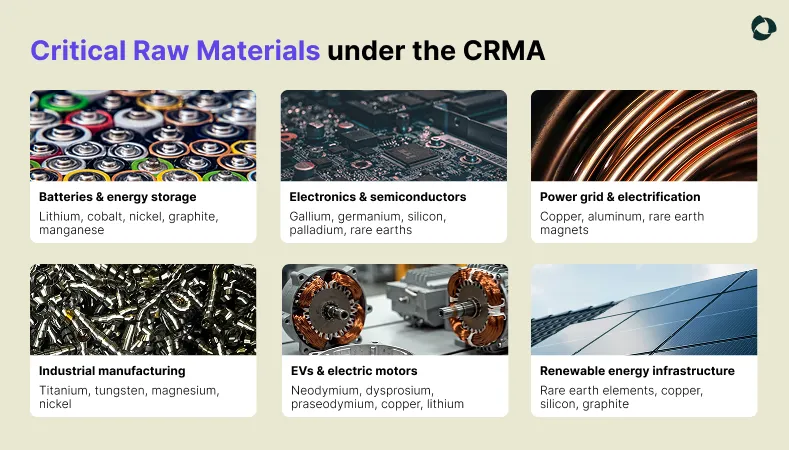
The EU's response was not simply to mandate more recycling, instead the CRMA sets four headline targets for 2030:
- Extract at least 10% of Europe's annual strategic raw material consumption domestically
- Process at least 40% within the continent
- Recycle at least 25%
- Reduce dependency on any single non-EU country to no more than 65% for any given material.
This is where sustainability policy starts to intersect more directly with supply chain strategy. Behind many environmental targets are broader concerns around access to critical materials, economic resilience and reducing dependency on volatile global supply chains.
What the CRMA does not do, at least not yet, is impose sweeping operational obligations on most manufacturers. There are no immediate recovery quotas forcing product redesigns by a fixed date. The regulation's current role is more structural: it shapes investment priorities, procurement expectations as well as the direction of future regulation. For businesses that prefer to be ahead of that curve, the question is less "do we have to comply?" and more "what does this tell us about where things are heading?"
Which industries are most exposed
Not all sectors face the same degree of exposure and the differences are worth understanding in detail.
Battery and electric vehicle manufacturers sit at the sharpest end of the CRMA's reach. Their supply chains depend directly on the materials the regulation is designed to secure. Battery recovery infrastructure, black mass processing, and take-back systems have moved from strategic aspiration to commercial necessity in this sector, partly because of the CRMA, but also because of the Batteries Regulation, which operates alongside it with more direct compliance obligations.
Electronics and semiconductor manufacturers face a different challenge. Their products contain high concentrations of copper, gold, palladium, and specialty metals, but recovery is operationally difficult. Products are complex, multi-material and often designed in ways that make efficient disassembly costly or impractical. The strategic exposure is significant but the path to operationalising recovery is harder.
Industrial manufacturers (machining, metal processing, advanced fabrication) often generate substantial quantities of production scrap, machining waste, and process residues. As raw material costs and supply risks have increased, these operational waste streams have become economically more valuable. A copper-bearing scrap stream that was once simply a disposal cost now increasingly represents future material supply.
Healthcare and MedTech present the most complex picture. Medical devices can contain recoverable materials, but sterilisation requirements, contamination risks, traceability obligations and regulated disposal streams create real operational barriers. But complexity doesn't eliminate the opportunity. In fact, well-designed take-back and recovery programmes can generate meaningful value and even create a significant competitive advantage in the hospital tendering processes especially because of the operational complexity in running such programmes.
What has changed operationally and what hasn't yet
The CRMA's direct operational impact on most manufacturers remains limited for now. Acknowledging this is not a reason to dismiss the regulation - it's a reason to understand it correctly.
What has changed is how businesses think about procurement and material risk. Companies with significant exposure to imported critical materials have been mapping supplier dependencies, identifying geopolitical concentration, and building contingency into sourcing strategies. And while the CRMA may have formalised and accelerated that conversation, that conversations was already happening in most businesses following supply chain disruptions in recent years.
Production scrap and operational material losses have also received more serious attention. Manufacturers have been asking which of their waste streams contain strategically valuable materials, whether those materials are being separated and recovered effectively, and what the economics of recovery look like as raw material prices remain volatile.
Product design is shifting too, albeit slowly. Products that are easier to disassemble, repair, refurbish and recover are becoming more attractive not just on sustainability grounds but on straightforward economics. In some sectors, recoverability is already becoming a procurement requirement from customers further up the value chain.
Take-back and reverse logistics systems have matured fastest in batteries and automotive, where regulatory pressure is most direct. But the logic has been spreading across electronics, industrial equipment and MedTech as organisations recognise that material value doesn't disappear when products leave the factory gate.
How the CRMA fits with CSRD, the Batteries Regulation and Digital Product Passports
The CRMA sits within a broader ecosystem of European regulatory initiatives that are collectively building the infrastructure for industrial transparency and material circularity at scale and understanding how they connect is more useful than treating each one in isolation.
The Corporate Sustainability Reporting Directive (CSRD) requires large companies to disclose material flows, circular economy practices, and supply chain sustainability which actually creates the reporting infrastructure through which CRMA-relevant data will increasingly need to flow. The Batteries Regulation, already in force, introduces mandatory recycled content requirements, take-back obligations and a battery passport requirement that makes material traceability a legal necessity for that sector. The Ecodesign for Sustainable Products Regulation is extending product design requirements across categories, and Digital Product Passports will make material composition and recovery information machine-readable and traceable across supply chains.
These regulations reinforce each other in practice. A business that invests in material visibility for CSRD reporting is building infrastructure that also serves CRMA preparedness, Batteries Regulation compliance, and eventual Digital Product Passport requirements. The businesses most exposed to regulatory risk are those treating each framework as a separate compliance exercise rather than recognising the underlying pattern: Europe is systematically building the conditions for tracking and recovering material value at industrial scale.
Why material visibility is the operational bottleneck
The practical challenge most organisations face is not a lack of ambition around circularity. It is a lack of visibility into what is actually happening to their materials. Information about material flows tends to be fragmented across supplier systems, ERP platforms, waste management reports, logistics providers, recovery partners and spreadsheets that nobody owns clearly. Even organisations that have made genuine commitments to circularity often cannot answer the questions that matter most: which materials carry the greatest supply risk, where material value is being lost in operations, which waste streams contain recoverable value and whether current recovery programmes are actually working.
This is what makes circularity an operational coordination challenge rather than simply a sustainability reporting exercise. A product can theoretically contain recyclable materials and still be practically impossible to recover, because the collection systems, disassembly economics, or recovery partnerships are not in place. Closing that gap requires data — not just aggregate recycling rates, but granular visibility into where materials move, where they stop moving, and what it would take to bring them back.
How Resourcify helps
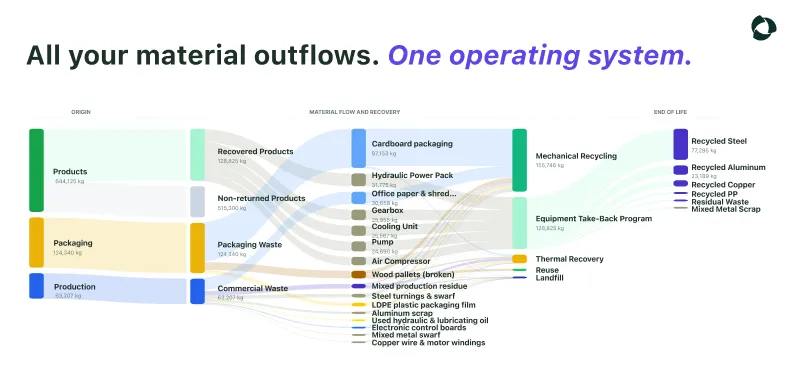
Most organisations that take CRMA seriously have already been through the cycle: an external consultant assesses the opportunity, a pilot launches at one site, and then nothing scales. The bottleneck is almost never ambition it is the operational reality of coordinating collection across the customers those products were sold to, finding the right recycling partners for each material stream, and managing the whole chain end to end. Nobody owns it, so nothing moves.
Resourcify runs the full programme. We assess your product catalogue against regulatory feasibility, operational complexity and recovery economics. We design and run the pilot. We coordinate the return flow and working with your customers and our vetted recycling network to get your end-of-life products back. Then we scale across your organisation, with digital reporting infrastructure built in throughout.
The difference is that we are not starting from scratch. With 3 million+ product, device and component collections already completed across 19 countries and 800+ vetted recycling partners in our network, the infrastructure that takes consultants years to build is already operational. For companies navigating CRMA's critical material recovery targets, that means the gap between strategic intent and measurable recovery outcomes is significantly shorter than most expect. If you want to find out more about how this could work in your business context, get in touch.




Trusted by



Get the latest insights delivered direct to your inbox
