Regulation
Resourcify Sustainability Index 2022: findings and methodology
Explore the historical 2022 analysis of waste and recycling disclosures from 40 DAX companies, with context on its methodology and limitations.

The Resourcify Sustainability Index 2022 examined waste and recycling disclosures from 40 DAX companies. This article presents the findings of that historical study, based on the reports available for the 2022 analysis. It is not a current ranking or a comparison of the companies’ performance in 2026.
To gather reliable figures on this topic, we took a closer look at the annual and sustainability reports of Germany's 40 largest companies. The result is the Resourcify Sustainability Index Report, which you can download here.
Summary of the key findings
- On average, the largest German companies recycle 61 % of the waste they generate
- 25% of the DAX companies fail to provide any information on their waste in the reports we analyzed or when requested to do so.
- "Recycling" is the most frequently used buzzword around circularity in annual reports.
- BMW and Mercedes Benz generate by far the most waste, but are setting a good example with outstanding recycling rates.
25% of German DAX companies did not report any waste figures
In the 2022 study sample, 10 of the 40 companies did not disclose the waste figures sought in the documents reviewed or in response to the research request. That finding describes the availability of information for this study; it does not establish that a company breached a reporting obligation.
39% of the waste generated is not recycled
The study reported an average recycling rate of 61% among the companies surveyed. Treat that figure as a result of the 2022 methodology and available disclosures. The remaining share cannot automatically be described as recyclable material or as waste sent to incineration without evidence of its composition and treatment.
Recycling is the most frequently mentioned topic by the DAX 40
To better understand what these companies are talking about in their annual reports, we defined keywords related to the circular economy. "Recycling" is mentioned most frequently in the reports, followed by "circular economy" in second place. Henkel and SAP are the two companies that talk the most about the circular economy and back up their statements with actions, as they are among the top-ranked companies in terms of recycling rates.
Comparability with the help of the Resourcify Sustainability Index
Throughout our research, we were able to source a large amount of publicly available data. To ensure comparability between companies, we combined all the researched metrics around the circular economy into one index - the Resourcify Sustainability Index (RSI). Since the companies operate in different industries, the index is almost entirely based on relative numbers to provide some degree of comparability. The RSI's composition and the standardization of metrics made for this purpose allows us to evaluate the actions of the companies at a glance. A key factor in the Resourcify Sustainability Index is the companies' recycling rate. Mercedes Benz, for instance, manages to rank highest despite producing 949,000 tons of waste. SAP and Siemens Health also score well, paying close attention to implementing circularity in their annual reports with cited measures, using many related buzzwords, and achieving good recycling rates.
For a more in-depth analysis, we recommend taking a closer look at the various key figures in our complete report. Download it for free.
The Resourcify Sustainability Index: How sustainable are German companies?
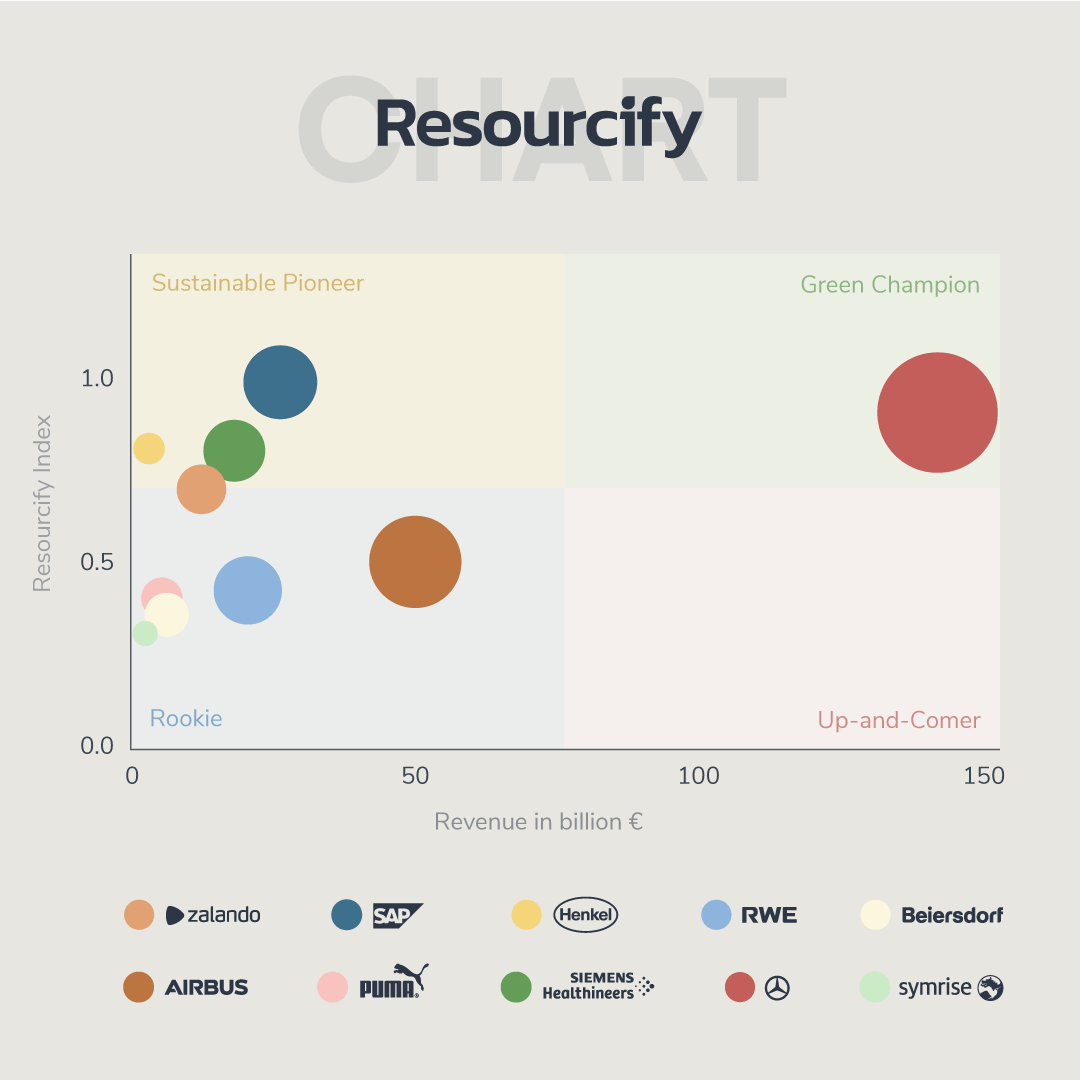
The data collected from these indicators provide the basis for the index figures and were also recorded in the form of two BCG matrices in which both the RSI and other variables such as company sales and the number of employees were visualized. As a result, the analysis demonstrates which DAX companies are performing best in the areas of sustainability, waste management and circular economy.
Based on their sustainability efforts according to RSI combined with revenue levels, the quadrants are named as follows: Green Champion, Sustainable Pioneer, Rookie and Up-and-Comer. For a deeper insight and the results of our analysis matrix, our extended report is essential, click here to download it.
“For some of the largest companies in Germany, the idea of a circular economy appears to have already taken hold. They track and communicate important key figures and are already planning or establishing measures to increase circularity. For others, however, there is still a lot of work to be done and we hope to see their strategies in the annual reports implemented in reality soon. Perhaps our study may even raise some awareness for this, because it's high time.” – Gary Lewis, CEO and Co-Founder, Resourcify.
Study methodology
The analysis used the annual and sustainability reports available at the time of the 2022 study. Indicators were weighted to compare aspects of waste management and circularity across different industries. Differences in disclosure, reporting boundaries and business models limit direct comparisons. The original report sets out the methodology and should be read alongside the results.
Follow the thread
Keep the ideas moving.
Circularity as an industrial strategy: the Critical Raw Materials Act (CRMA)
How the EU Critical Raw Materials Act (CRMA) is reshaping how manufacturers think about supply chain resilience, material recovery and circularity.
CSRD waste reporting: preparing reliable ESRS E5 data
Prepare waste data for ESRS E5 with clear boundaries, consistent treatment categories and traceable evidence. Includes the 2026 CSRD scope changes.

The EU’s Updated ELV Regulation for Auto Manufacturers
Circularity is evolving in automotive. The updated EU ELV regulation introduces new recycled content targets and operational challenges across material flows.